

AI tools put to the test: building prototypes with Lovable, Claude Design and Cursor
Lovable, Claude Design or Cursor: which AI tool is best for building a convincing prototype without any programming skills? A practical test shows where the tools shine, where their limits lie and which solution is the best choice for decision-makers in medium-sized businesses.

 Trends
A few years ago, a clickable prototype was handiwork in design tools such as Figma, Sketch or Adobe XD. Today you type a prompt into a text field: “Build me an app for team holiday planning, with an overview calendar, a request form and approval by the manager.” A few seconds later, something opens in the browser that not only looks like a real application but can also be used like one. This approach is called vibe coding, and it is changing how new ideas are discussed in medium-sized businesses.
Why this is no longer a niche topic
Many decision-makers have not yet fully registered the leap that vibe coding has made. At the end of 2025, the Collins English Dictionary named “vibe coding” its word of the year. The term was coined in early 2025 by Andrej Karpathy, co-founder of OpenAI. The idea behind it is as simple as it is far-reaching: you describe your plan in everyday language, and the AI translates it into working software.
A look at the figures shows how serious this movement has become. Lovable, founded in Stockholm in 2023, grew to more than 500 million US dollars in annual recurring revenue within two years and is currently valued in the tens of billions. Around 200,000 new projects are created on the platform every day. Its customers now include corporations such as Uber, Zendesk, Klarna and McKinsey. Cursor, the tool for the more technical audience, passed the mark of four billion US dollars in annual revenue in 2026 and has long been standard in large companies.
Even so, the attitude “that won't work anyway” is still widespread. It comes from a time when AI-generated prototypes really did look odd. That time is less than two years ago, and it is over. What is created in a few hours today, you would not have recognised as a prototype until recently. Anyone who has not yet seen the development for themselves is working with an outdated picture in their head.
But which tool should you use? Three tools currently dominate the field: Lovable, Claude Design and Cursor. All three promise to turn an idea into a working prototype. They differ considerably in usability, quality of results and target audience, however, and that is exactly why a comparison is worthwhile.
Lovable: the easy way in
Lovable was the first tool of its kind that we tried out at Werkdigital. The service had gathered a great many users in a short time, and no wonder: it is being promoted heavily. In principle, anyone can use Lovable. Enter a prompt, wait, done. Lovable indeed.
The design is particularly striking. You have to give Lovable surprisingly little input, and still something emerges that looks good. For non-specialists who want to make an idea tangible for the first time, that is ideal.
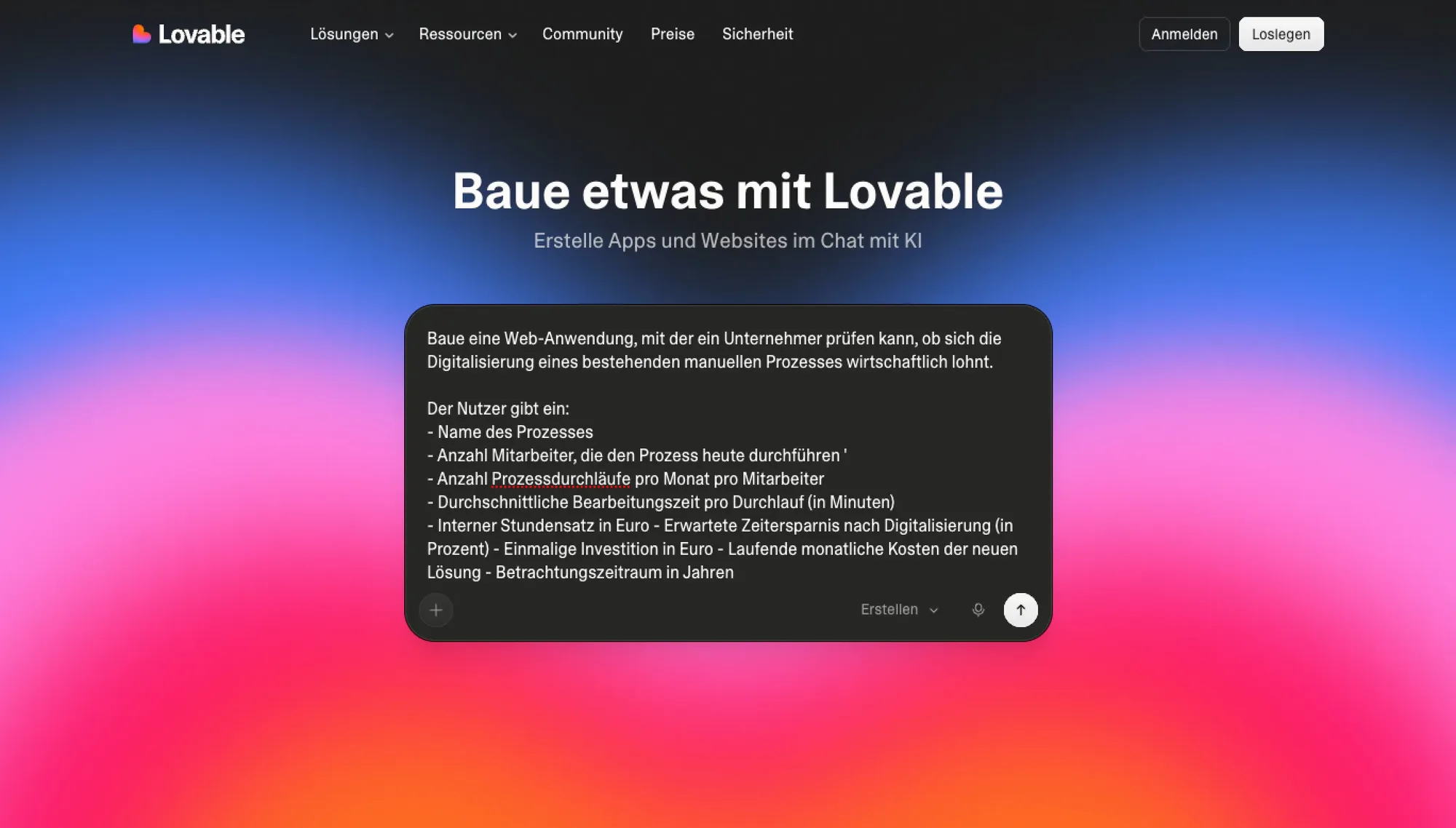
Turning the prototype into a finished product, on the other hand, is laborious. In our tests, there were repeated discrepancies between what we had described in the prompt and what actually came out. Misunderstandings piled up, and some requests were not addressed at all. For a prototype, that is no disaster. For product development at a professional level, there are better tools.
The prices on lovable.dev are within a range that is easy to budget for individual projects and small teams.
Cursor: the technical powerhouse
The second tool in our test was Cursor, a much more technical solution. While Lovable runs in the browser, Cursor has to be installed as an application on your own computer. That is the first hurdle, and it is not the last.
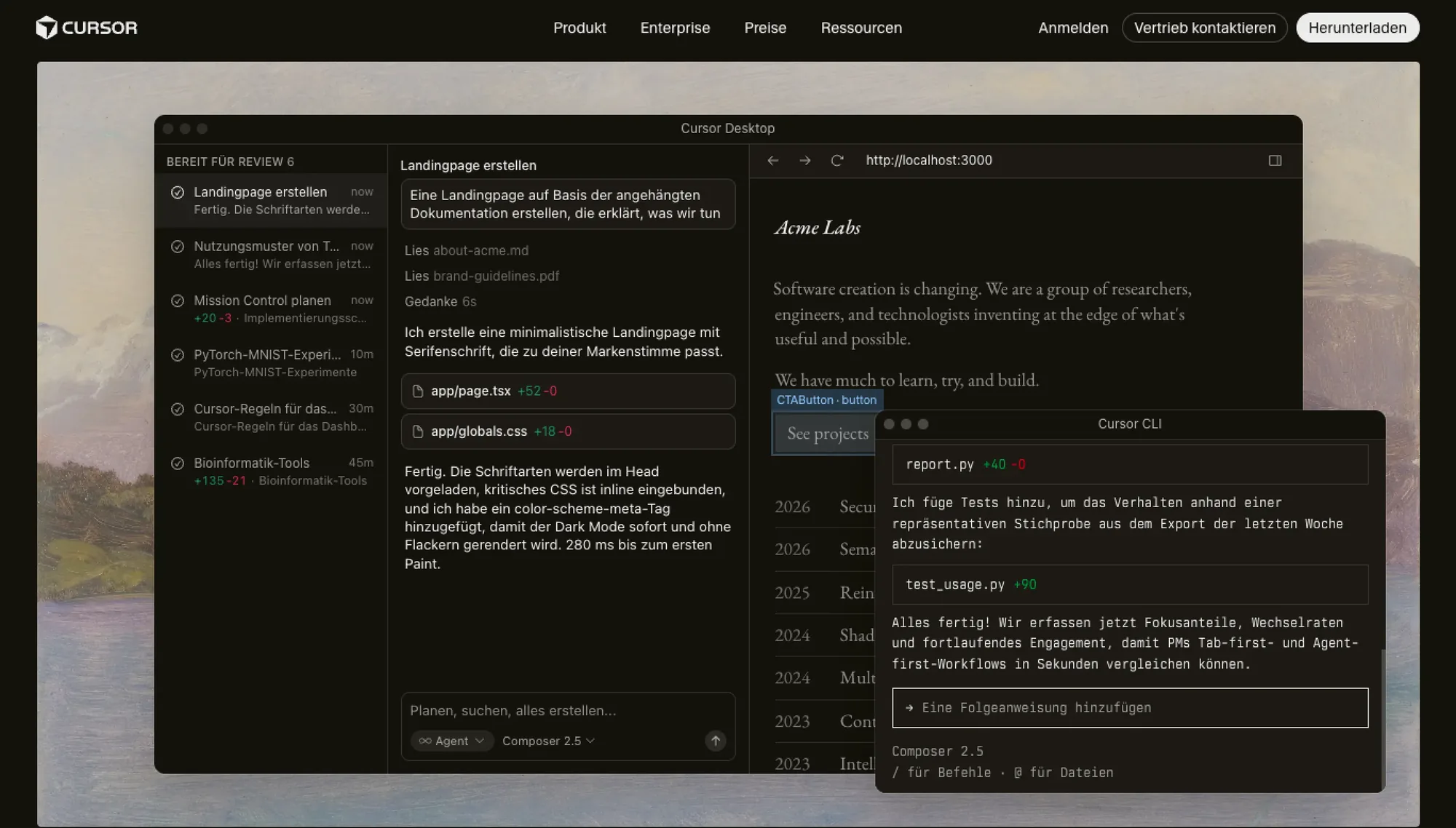
To start a new project, even a simple prototype, you first have to set up a local development environment. Create a project directory, install Node.js, choose the right framework and install the dependencies with npm install. Doesn't mean anything to you? Me neither. Cursor guides you through these steps quite well with AI support, and for people who have already built a more complicated Excel spreadsheet with references and macros, getting started is manageable. But it remains a tool for programmers.
The results are good, both visually and functionally. Once everything is up and running, working together with the AI is surprisingly intuitive. But the complexity of setting up the development environment makes it hard for many users to work with Cursor. For many, it is simply impossible at this level.
Claude Design: the best choice for designers
At Werkdigital we were already using Claude Code from Anthropic in development. So when the company followed up with Claude Design, our curiosity was correspondingly great.
What you can achieve with Claude Design in a very short time is at least as impressive as with Lovable. For those who love detail, the precision is especially pleasing. You get what you describe. Anyone who phrases their request with specialist vocabulary feels understood straight away. For people with design expertise, Claude Design is therefore the strongest tool in the whole field.
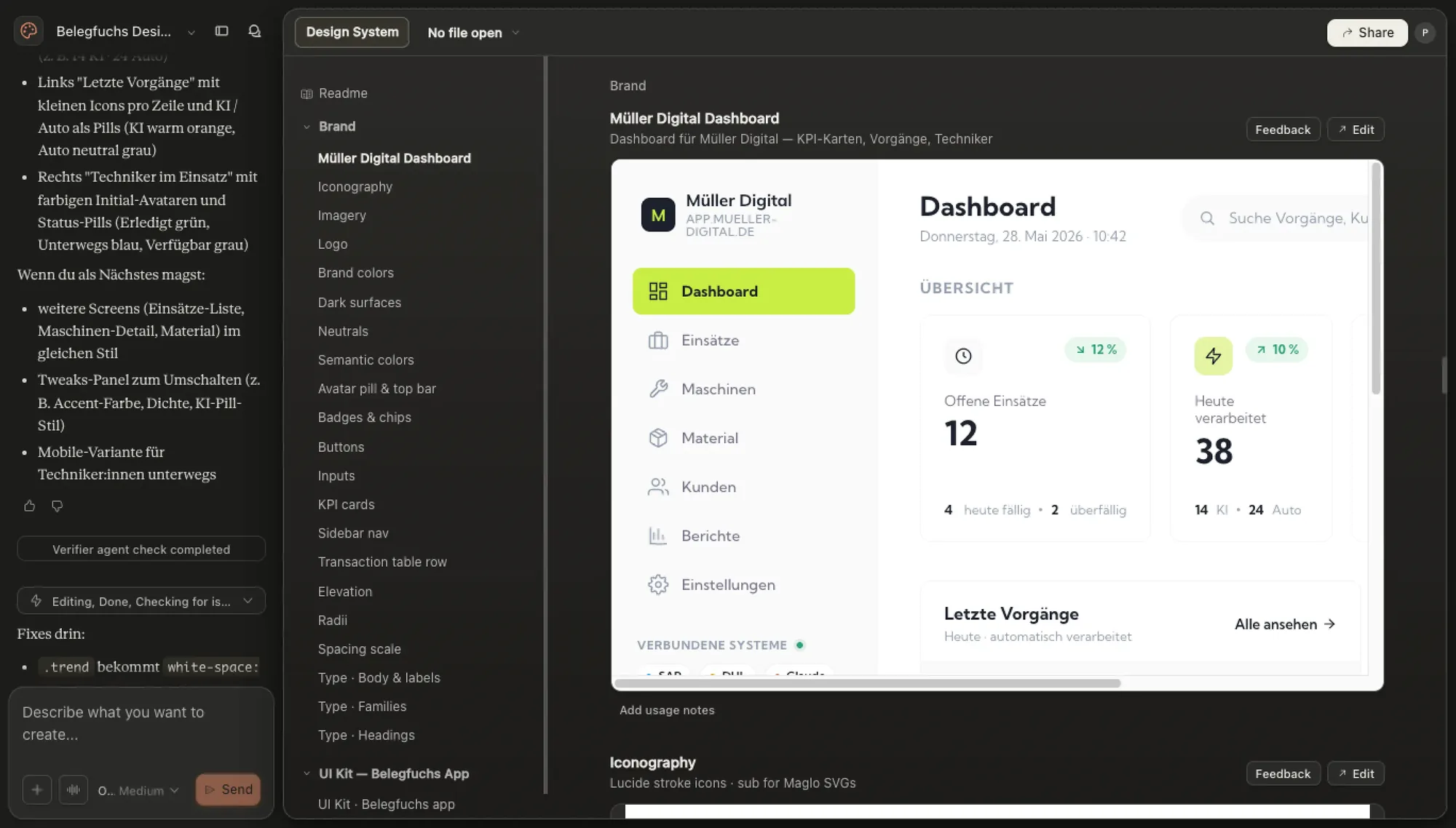
Non-specialists can use it, but it is not quite as intuitive as Lovable. Anyone who struggles with design terms will reach their goal faster with Lovable. Anyone who has a clear idea, can describe it precisely and has mastered the basics of design will get the most out of Claude Design.
The winner for medium-sized businesses
For decision-makers in medium-sized businesses who want to make an idea tangible quickly, there is currently no way around Lovable. Cursor is ruled out for most, because the technical barrier to entry is too high and setting up a development environment takes time that nobody in management wants to free up. Claude Design delivers more precise results and is the stronger tool for users with design expertise, but in return it demands a vocabulary and understanding that many decision-makers cannot call up immediately in their day-to-day business.
Lovable gets by with a short prompt in everyday language and, after just a few minutes, delivers a result that looks good, can be used and is actually handled in a meeting. Without prior knowledge and without any technical setup. That the result does not turn directly into a finished product is secondary for this first step. A tangible prototype ends discussions that would otherwise go round in circles for months.
From prototype to decision: the compact course
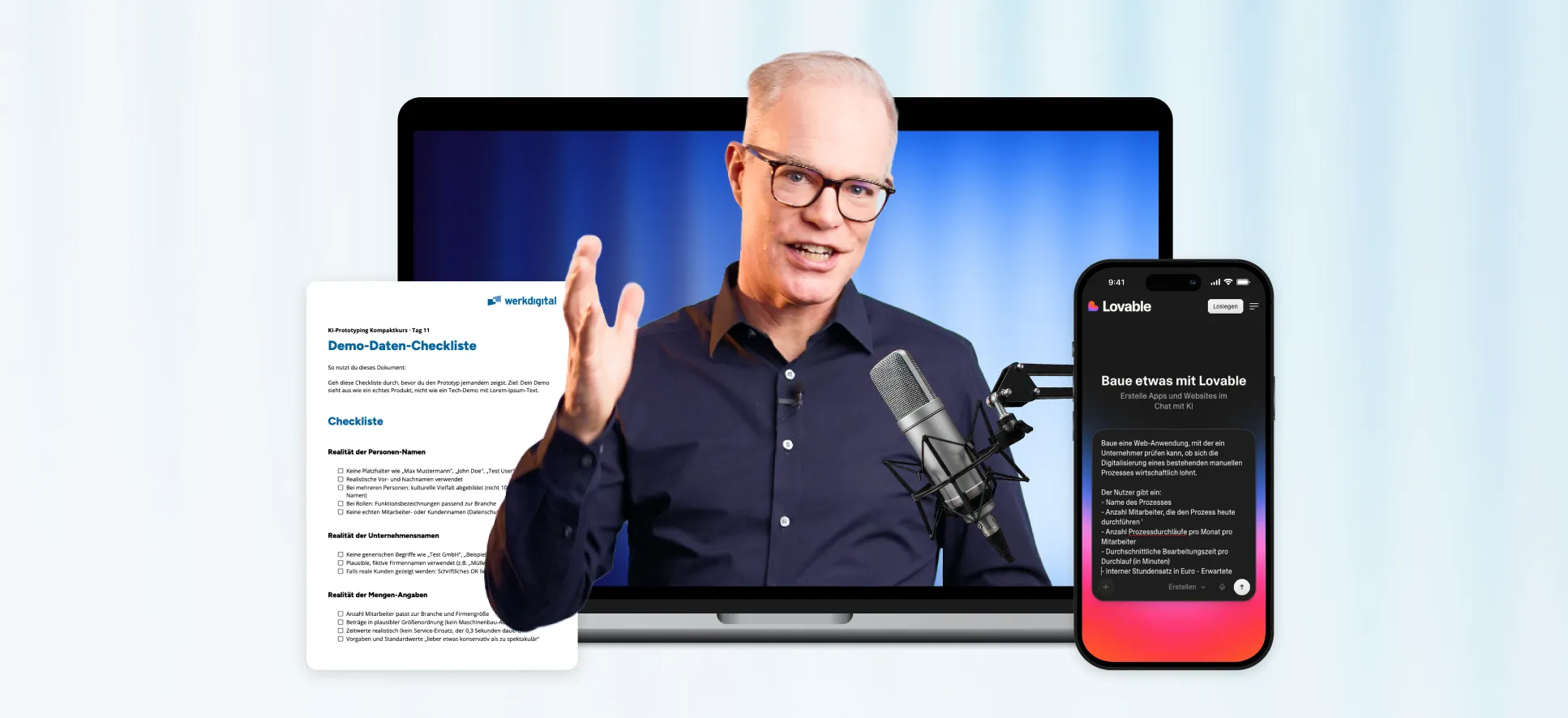
A tangible prototype is proof that an idea can work. Before it becomes a project, two things belong on the table: a reliable idea of what the prototype should achieve, and an honest calculation of whether the project is worthwhile at all. This is exactly where the AI prototyping compact course comes in, designed by Boris Feldmann, founder and managing director of Werkdigital.
Over fourteen days, participants learn to think an idea through in a structured way with AI tools, turn it into a clickable prototype and, at the same time, assess its economic viability properly. They identify a specific process in their own company, determine the possible time and cost savings realistically and, on that basis, draw up a reliable ROI calculation. The result is not finished software but something that is often missing in medium-sized businesses: an informed decision.
The online course runs over two weeks and is aimed explicitly at decision-makers without a technical background. The target group is neither technicians nor designers, but people who decide on investments in their company. You will find details, the programme and the terms on kompaktkurs.werkdigital.de.
Conclusion
Vibe coding convinces you most honestly when you try it yourself. Take an idea that has been on your mind for a while anyway, open Lovable and see what comes of it. The time required is surprisingly small, the results are not. Within an afternoon, a vague thought turns into something visible that you can show to your team, try out and develop further. Rarely has the path from an idea to its tangible reality been so short. Anyone in a medium-sized business who wants to work with AI should experience this new ease on their own screen at least once.
A prototype is still a prototype, though. It does not bring with it topics such as data protection, transaction security and scalability, and that is exactly what separates visible proof from software that works in everyday use with real users, real data and real transactions.
For the path from idea to a viable prototype and a sound business case, the compact course gets you there in fourteen days, with Lovable, incidentally. For the path from prototype to product, the experts at Werkdigital are ready to help.
Vibe coding refers to creating software or clickable prototypes with the help of artificial intelligence. Instead of programming yourself, you describe your idea in natural language. The AI tool then translates your requirements into a usable application.
For decision-makers without programming skills, Lovable is particularly suitable, as the tool is easy to use and delivers attractive results quickly. Claude Design offers more precision for users with design experience. Cursor is aimed primarily at developers and technically experienced users.
Yes, with AI tools such as Lovable you can create clickable prototypes without programming skills. Such a prototype helps to visualise ideas and test them internally. For productive software, data protection, security, scalability and technical quality, among other things, then have to be taken into account.
Let us talk about your ideas and challenges, in a relaxed way.
Book an initial assessment
We value your privacy
We use cookies and other technologies on our website. Some of them are technically necessary, while others help us to improve this website and your experience. You can accept all cookies or adjust your settings individually and reject non-essential cookies.