

Je m'appelle Claude: making AI ideas happen in medium-sized businesses
Heinrich Brinkmann, managing director of a mechanical engineering company in the Sauerland region, has had a new colleague for a few weeks: Claude, available around the clock, 18 euros a month. This article shows what Claude is really good for in medium-sized businesses, where its limits lie and how to set it up in a GDPR-compliant way from the outset.

 Trends
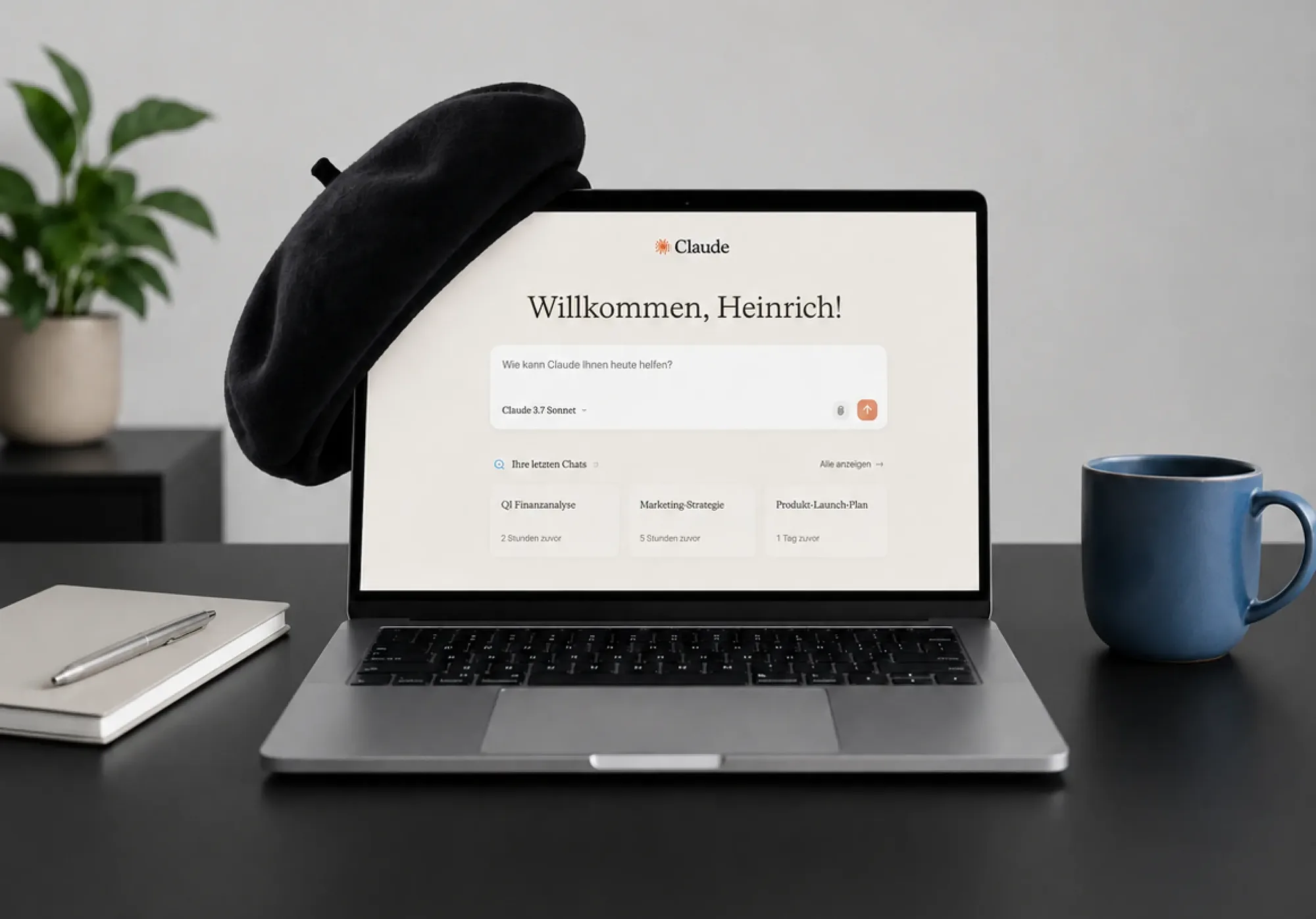
Heinrich Brinkmann, 58, third-generation managing director of a medium-sized mechanical engineering company in the Sauerland region, has a new employee. Her name is Claude, she is available around the clock, never complains about the coffee in the kitchen and costs 18 euros a month. Brinkmann, by the way, is convinced that Claude is a woman. His son laughs at him: “Dad, Claude is a “he”. And not a person.” Brinkmann shrugs. “Well, he does a good job.”
It is Wednesday afternoon, just after three. Brinkmann types a sentence into an empty input field: “Give me an overview of the most important funding programmes for investments in manufacturing companies in North Rhine-Westphalia, with application deadlines, please.” Four seconds later, the answer arrives. Structured, polite, in the tone of a consultant who really costs too much. Brinkmann reads it, nods and sends the whole thing to his tax adviser. Ten minutes later the reply comes: “Neat work. Who did this?” Brinkmann grins. “A new colleague. Claude. She is from California.”
What sounds like a lunch-break anecdote is happening a little more often in the offices of German medium-sized businesses every day. And it is more than a gag. Because what Brinkmann has just done, a funding search that would previously have taken his assistant two hours, is exactly where Claude can save real time in medium-sized businesses. If you know how.
Who or what is Claude, actually?
Claude is not a French intern, but a so-called “large language model”: a language model trained on gigantic amounts of text that produces natural-sounding answers. Behind it is Anthropic, a US company from San Francisco founded by former OpenAI researchers. Functionally, Claude is similar to well-known tools such as ChatGPT or Gemini. In practice, however, there are differences that are particularly interesting for medium-sized businesses:
- Claude reads very long documents in one go, such as complete contracts, annual reports or data sheets with hundreds of pages.
- Its answers are often more structured and more carefully worded, which comes across better in a B2B context.
- Anthropic explicitly positions itself as a “safety-first” provider with a focus on responsible AI.
At first, that sounds like marketing speak. In everyday use, though, you notice the difference at the latest when you drop an 80-page PDF in Claude’s lap and get a clean summary back ten seconds later, including a reference to the right page. Heinrich Brinkmann calls this “colleague Claude getting up to speed”. His son rolls his eyes.
Five things Claude is really good at in medium-sized businesses
Enough theory. On a perfectly normal Thursday in a perfectly normal business, it becomes clear where Claude adds value. Five use cases that we at Werkdigital see again and again.
1. Understanding offers, contracts and tenders
A 60-page tender lands in your sales team’s inbox. Until now: three hours of reading, a cup of coffee, a mild headache, and at the end a deadline is still missing somewhere. With Claude: upload the PDF, ask “What are the most important requirements, deadlines and exclusion criteria?”, and the answer comes back structured. You still have to read it. But now you know where to look.
2. Drafting emails and letters
The scenario probably sounds familiar: you want to turn down a difficult client politely but firmly. You know exactly what you want to say, you just cannot find the right words. Half an hour later you have written three versions and like none of them. Claude delivers a first draft in 30 seconds that you only need to adjust. Your tone, your words, just faster. Brinkmann says: “Claude writes the first draft, I turn it into the letter.”
3. Summarising meetings and extracting tasks
You have had a one-hour strategy meeting. The transcript is 18,000 words long. Claude is given it to read and delivers: a summary, a list of the decisions made, a list of open points and a to-do list for each person. In two minutes. Something that used to take the assistant two hours, and was still incomplete at the end because he had gone to get coffee at the crucial moment.
4. Formulating data analyses without SQL skills
You have an Excel spreadsheet with 5,000 rows of customer data. You want to know: “Which customers ordered the most in the last twelve months, but nothing at all in the last quarter?” In the past: sales asks controlling, controlling asks IT, IT builds a pivot table, and three days later an answer arrives. With Claude: you upload the spreadsheet, ask the question in plain English, and get the answer. Today. Before lunch.
5. Drafting concepts, presentations and training
You need an internal training concept on “safety briefing in the warehouse”. Claude writes you a first version with learning objectives, content, a schedule and quiz questions. Not perfect. But 80% closer than the blank Word document you would otherwise have been staring at.
The pattern is always the same: Claude does not replace the expert. It takes the tedious first draft off their hands.
The most important question first: what about data protection?
This is where it gets serious. And it is exactly the right question, because anyone who simply opens Claude (or any other AI) in a browser and pours business data into it has a problem. Brinkmann’s data protection officer, for example, had a minor nervous breakdown in the first week of the “Claude phase”. Today everything is properly regulated. The most important points for medium-sized businesses at a glance:
- Standard access via the Anthropic website is not suitable for confidential business data. Processing takes place on US servers, without a robust GDPR basis.
- Claude for Work and API access via European cloud providers (e.g. AWS Bedrock or Google Cloud Vertex AI in Frankfurt) enable EU-based processing, data processing agreements and clearly defined retention periods.
- With correctly set up business access, inputs are not used to train new models; this is contractually guaranteed.
- Personal data (customer names, employee data, health data) only belongs in Claude once the legal basis has been checked: a data processing agreement, clearly defined purposes, a documented role as processor.
In short: yes, Claude can be used in a GDPR-compliant way. But not in the “managing director quickly opens the free web version and uploads the customer database” variant. Rather, in a properly set up business environment, just as you would not run your email server on the open Wi-Fi at the railway station.

Five typical pitfalls and how to avoid them
“Let’s just try it out.”
Sounds relaxed, but it is the most common source of data protection incidents. If three employees are typing away in Claude or ChatGPT at the same time with their private accounts and using real customer data there, you have a shadow IT problem. The solution: clear ground rules and one official access for everyone.
“We’ll just take the cheapest plan.”
Understandable. But the free or cheap private plans generally do not come with data protection terms fit for business. The extra cost of a business account is usually negligible compared with the risks. Brinkmann says: “I pay less for Claude than for my company mobile plan. And Claude does not grumble when I call him at the weekend.”
“AI gets everything right anyway.”
It does not. Claude occasionally invents sources, mixes up numbers and is sometimes convincingly wrong. In technical jargon, this is called “hallucination”. In plain terms: every AI answer must be checked for plausibility before it leaves the building.
“We need a strategy first, before we start.”
Yes and no. Nobody in a medium-sized business needs an 80-page AI strategy. What you really need is a clear guideline (what may go in, what may not?), an official access and a few people who build up experience. You develop the rest iteratively.
“The tool should be able to do everything, and right away.”
Claude is not an ERP, not a CRM, not an accounting tool. It is an assistant for language, text and analysis. Anyone who sees AI as a replacement for specialist software will be disappointed. Anyone who sees it as a complement will gain time.
Get started in three steps, without risk
This is what a realistic start looks like for a medium-sized business:
Step 1: collect use cases. Ask your departments where they spend the most time on texts, emails, summaries or research. This produces a list of the five to ten most promising use cases.
Step 2: set up GDPR-compliant access. A business account or API access via a European cloud provider, with a data processing agreement, clear ground rules and a short internal policy. One page is enough.
Step 3: train a pilot group. Three to five people from different areas, half a day of training, a four-week pilot phase. Then you evaluate what works, what does not and where to expand.
That’s it. No grand strategy, no IT project with a steering committee. A few sound decisions at the start, and then learning as you go.
What you will think afterwards
After two or three months of working with Claude (or a comparable AI), the way you look at your own business changes. Suddenly you keep noticing tasks you used to do by hand as a matter of course. Weekly reports. Market research. Job adverts. Draft contracts. Translations. And the reflex is no longer “I’ll just do it myself”, but “I’ll give it to Claude and then check it”.
That is exactly what process optimisation with AI in medium-sized businesses is. Not rocket science. Not a new ERP system. But an additional employee who never gets ill, never takes holiday and needs no lunch. Who, however, should never make decisions alone.
Werkdigital supports medium-sized businesses on exactly this journey, from use case analysis and GDPR-compliant set-up to training the teams. As an authorised INQA coach, we can include state funding grants of up to 80 percent for suitable projects, so that an AI pilot project remains plannable not only in technical but also in economic terms.
Heinrich Brinkmann, by the way, stopped addressing Claude so formally last week. “We have known each other a while now.” His son has given up.

Claude is an AI language assistant from the US provider Anthropic. Functionally it is comparable to ChatGPT, but differs in a few respects: Claude processes very long documents in one go, often answers in a more structured way in a B2B context and places a strong focus on safety-oriented AI answers. For many applications in medium-sized businesses, such as contract analysis, document summaries or reporting, this is a noticeable advantage.
Yes, but not via the free web access. For business use, you need a business account or API access via a European cloud provider (e.g. AWS Bedrock or Google Cloud Vertex AI in Frankfurt), combined with a data processing agreement. Inputs must not be used to train new models, and retention periods are contractually defined.
Claude is particularly useful for text-heavy tasks: analysing contracts and tenders, drafting emails and letters, summarising meeting transcripts, simple data analyses of Excel spreadsheets or first drafts of concepts, presentations and training. Claude is not suitable as a replacement for ERP, CRM or accounting software.
The costs depend on the usage model. Business accounts for teams start at a few euros per user per month. With API-based integration into your own systems, costs are charged per text processed; in medium-sized businesses, typical workloads are in the low three- to four-figure range per month. In any case, the bigger lever is not the licence costs, but the staff hours saved.
In three steps: (1) collect specific use cases from the specialist departments, (2) set up GDPR-compliant business or API access with a clear usage policy, (3) start with a pilot group of three to five people for four weeks. Only then do you decide on a wider roll-out.
Let us talk about your ideas and challenges, in a relaxed way.
Book an initial assessment
We value your privacy
We use cookies and other technologies on our website. Some of them are technically necessary, while others help us to improve this website and your experience. You can accept all cookies or adjust your settings individually and reject non-essential cookies.