

The 5 most common digitalisation mistakes in medium-sized businesses
Find out which digitalisation mistakes medium-sized businesses make most often and how you can avoid them with the right strategy.

 Digitalisation
 in medium-sized businesses: why do so many projects fail?
For medium-sized businesses, digitalisation has long ceased to be an option; it is vital for survival. Yet current figures show that around 70% of all digitalisation projects in medium-sized businesses do not achieve their goals or fail completely.
That is alarming, because digitalisation offers enormous opportunities, especially for medium-sized businesses with high-quality products: from opening up new markets and optimising internal processes to developing innovative business models.
So why is the success rate so low? As digitalisation experts with more than 13 years of experience supporting medium-sized businesses, we have identified the five most common mistakes that lead to failure, and we show you how to avoid them.

Mistake 1: digitalisation without a clear strategy and defined goals
The problem
Many medium-sized businesses start their digitalisation projects with the vague goal of “becoming more digital”. Without specific goals and a well-thought-out strategy, however, this is like jumping in at the deep end, with an uncertain outcome.
The solution
Always begin your digitalisation projects with a careful analysis of your current situation and a clear definition of your goals:
- Carry out an as-is analysis: where do you currently stand in terms of your digital maturity?
- Define goals: which specific goals do you want to achieve with digitalisation? (e.g. process optimisation, cost reduction, new business models)
- Business case: what ROI do you expect from your digitalisation project?
- Draw up an action plan: which specific steps are necessary to achieve your goals?
At Werkdigital, we rely on our proven “Insight Method”, which works through exactly these points systematically. This ensures that every digitalisation project rests on a solid foundation and delivers measurable results.
Mistake 2: underestimating change management
The problem
Technical implementation is often only half the battle. Many digitalisation projects fail because employees are not sufficiently involved and resistance arises. New technologies then remain unused or are only used reluctantly.
The solution
A successful digitalisation project requires well-thought-out change management:
- Involve employees early: include your employees in the process from the start and make them co-creators of the change.
- Communicate clearly: explain why digitalisation is necessary and what benefits it brings for the business and its employees.
- Training and support: make sure there is sufficient training and reliable support so that your employees can work with the new technologies.
- Celebrate successes: make progress visible and celebrate milestones you have reached together.
Mistake 3: wanting too much at once
The problem
The wish to digitalise the business in one go often leads to overload and frustration. Complex, all-encompassing digitalisation projects take too long, are too expensive and often fail because of their own complexity.
The solution
Take a step-by-step approach:
- Prioritise your digitalisation projects: which areas promise the greatest benefit for a manageable effort?
- Think in stages: divide large projects into smaller, manageable sub-projects.
- Enable quick wins: start with projects that deliver visible results in a short time.
- Work agile: work in short development cycles and adapt your strategy as needed.
At Werkdigital, we work in 2-week build phases that we call “sprints”. This allows our clients to follow progress continuously and make adjustments early on if necessary.

Mistake 4: choosing the wrong technology or solution
The problem
The market for digitalisation solutions is confusing. Many businesses opt for standard solutions that do not suit their specific requirements, or for technologies that are not future-proof.
The solution
Carefully selecting the right technology is crucial:
- Needs analysis: analyse your specific requirements before deciding on a solution.
- Make or buy: check whether a standard solution is sufficient or whether bespoke development makes more sense.
- Future-proofing: pay attention to the scalability and future viability of the chosen technology.
- Integration: make sure that new solutions can be integrated into your existing IT landscape.
At Werkdigital, we rely on proven technologies with broad support in the global developer community. This ensures that our solutions are sustainable and future-proof, an important aspect of our 11-point guarantee.
Mistake 5: no measurement of success and no continuous optimisation
The problem
Many digitalisation projects end with the introduction of the new technology. But without continuous measurement of success and optimisation, potential is wasted and problems go unrecognised.
The solution
Digitalisation is not a one-off project, but a continuous process:
- Define KPIs: set measurable success criteria.
- Monitor regularly: continuously check whether your digitalisation goals are being achieved.
- Gather feedback: regularly collect feedback from users and employees.
- Optimise continuously: adapt your solutions based on the insights gained.
With our service contract, we offer our clients not only technical support, but also regular reviews and optimisation suggestions to ensure the long-term success of their digitalisation projects.
Making digitalisation a success: the Werkdigital approach
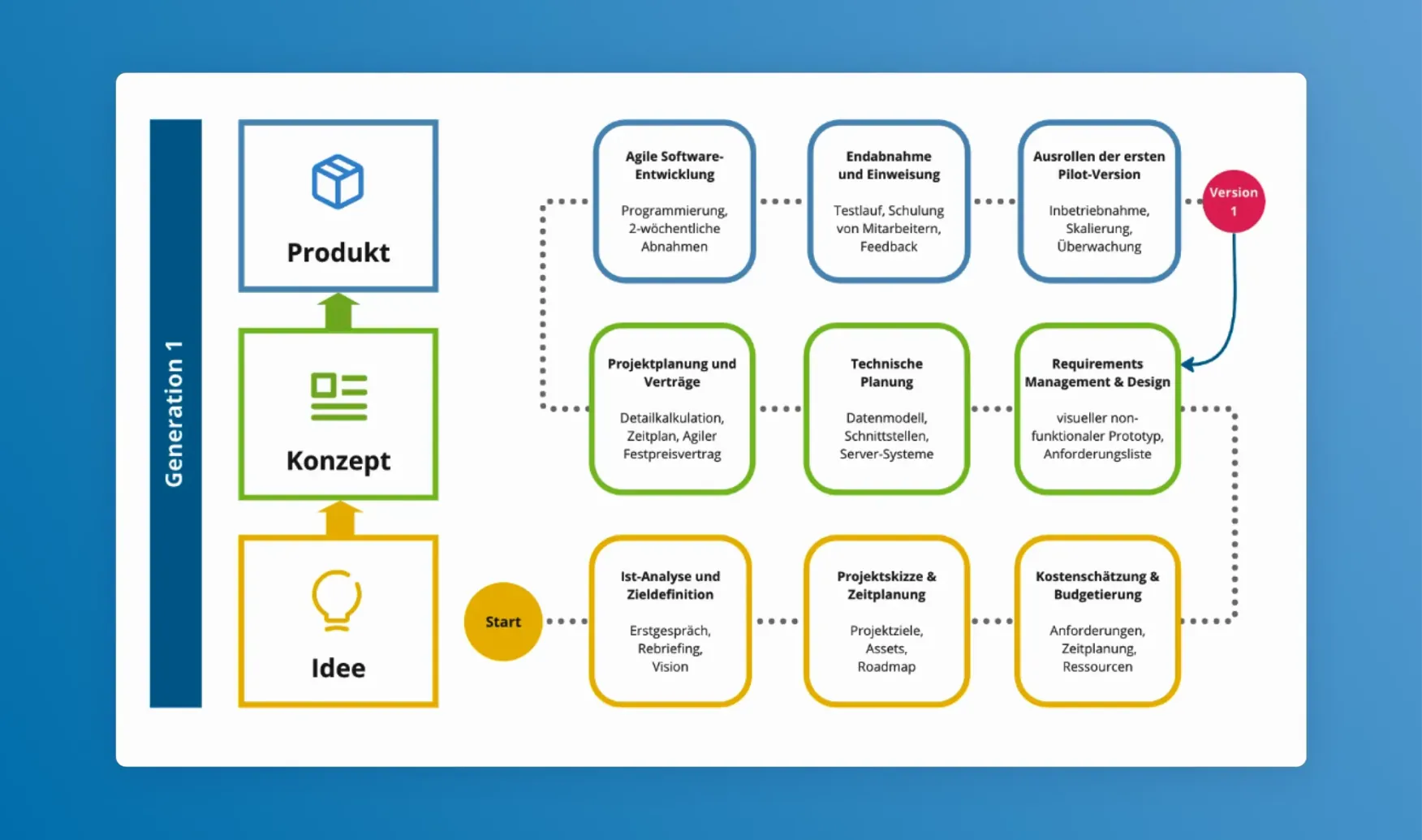
To avoid the mistakes described, we at Werkdigital have developed a proven 9-stage process that guides medium-sized businesses safely through their digitalisation projects:
1. Careful analysis
- Honest as-is analysis
- Clear definition of goals
- Business case
- Project outline & budgeting
2. Comprehensive design
- Requirements, design and functionality
- Technical design
- Detailed project plan
3. Efficient product development
- Agile software development in 2-week build phases
- Continuous testing
- Maintenance, support and further development
This structured approach minimises risks and maximises the success of your digitalisation projects.
Conclusion: digitalisation in medium-sized businesses is a question of the right approach
Digitalisation offers medium-sized businesses enormous opportunities, but also involves risks. The five most common mistakes (a lack of strategy, neglected change management, overly ambitious projects, the wrong choice of technology and inadequate monitoring of success) can be avoided with the right approach.
With an experienced partner at your side who understands your industry and your specific challenges, you can implement your digitalisation projects successfully and create lasting added value for your business.
Are you facing the challenge of digitalising your business or implementing a specific digitalisation project? We will be happy to support you with our expertise and our proven approach.
Book a free initial assessment now, in which we can discuss your digitalisation goals together and develop an initial roadmap.
The costs of digitalisation projects vary greatly depending on scope and complexity. What matters is a thorough business case before the project starts, to determine the ROI and justify the investment. At Werkdigital, we offer transparent cost estimates and agile fixed-price contracts so that you have planning certainty from the outset.
The duration depends on the scope of the project. Smaller projects can be implemented within a few weeks, while more extensive projects can take several months. However, thanks to our agile approach with 2-week development cycles, we can deliver first results quickly and create continuous added value.
This decision depends on your specific requirements. Standard solutions can be cheaper, but often offer less flexibility. Bespoke software, on the other hand, is tailored precisely to your needs and can give you a competitive advantage. In an initial consultation, we analyse together which approach makes the most sense for you.
The key lies in early involvement, clear communication and sufficient training. Show the benefits of digitalisation for everyday work and make employees co-creators of the change. Our change management approach helps you guide your employees successfully through the process of change.
Projects for process optimisation and automating recurring tasks often offer a quick ROI. Digitalising customer service or introducing digital sales channels can also pay off quickly. In our initial assessment, we identify the “low-hanging fruit” in your business together.
Let us talk about your ideas and challenges, in a relaxed way.
Book an initial assessment
We value your privacy
We use cookies and other technologies on our website. Some of them are technically necessary, while others help us to improve this website and your experience. You can accept all cookies or adjust your settings individually and reject non-essential cookies.