

From the carport to the cowshed: can digitalisation work anywhere?
Digitalisation does not always start with AI, platforms or huge projects. Sometimes it begins quite unspectacularly in the carport and shows its impact a little later in the cowshed.

 Digitalisation
Berta snorts nervously as inseminator Thomas Lammers lifts the box labelled “Brutus” out of the boot. An entirely normal morning on a livestock farm in the Eifel, and at the same time a pretty good example of a question many businesses are asking: does digitalisation actually work everywhere, and how do you make digitalisation succeed in a business, whatever the industry?
The answer is right in front of us. Because before Lammers even arrives at the cowshed, digitalisation has already started in the carport. His electric car was charged automatically overnight, controlled by an app, with electricity from his own solar panels. No effort, no planning.
Now inseminator Lammers is standing in the cowshed and reaching not only for the cool box, but also for his tablet. The mating software “BEAT” uses genetic data to calculate the perfect match for his client Berta. Pedigree, performance figures, breeding goals. Information that used to be scattered, incomplete or hard to compare now feeds into a well-founded decision within seconds. Berta is in luck: Brutus the bull is not related to her.
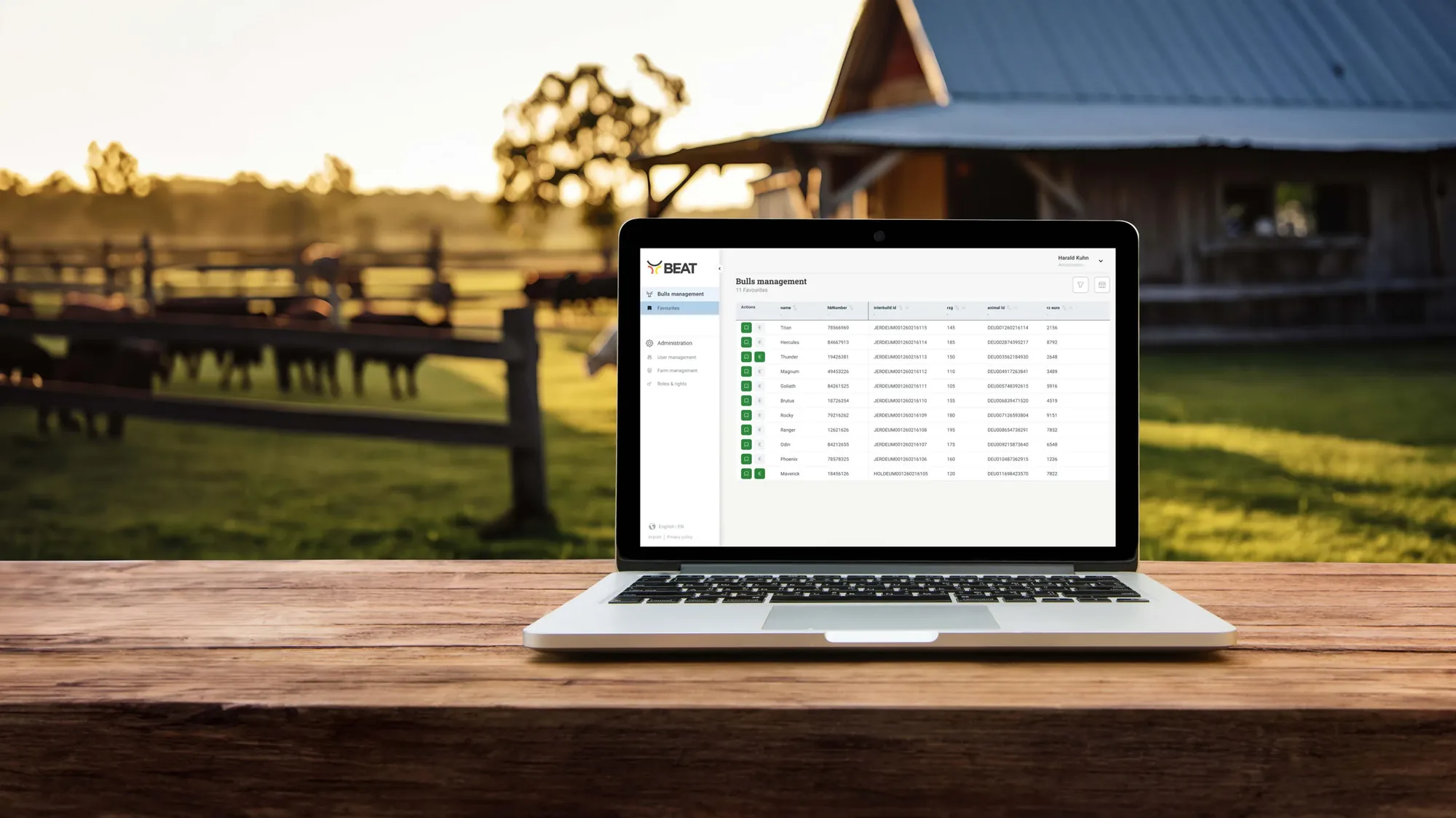
At this early hour, Lammers has already benefited from digitalisation twice, from smart applications that make life easier. An e-mobility app and mating software. What seems to have nothing in common at first glance follows the same principle at its core. Processes become more transparent, data-based decisions become possible and workflows become plannable. That is exactly why digitalisation does not only work in certain industries, but anywhere there is friction.
Digitalisation has an image problem
What do you think of when you hear the word “digitalisation”? People who talk about it often mean large platforms, artificial intelligence and business models that turn entire industries upside down. And yes, all of that exists. It sounds impressive, but often has surprisingly little to do with reality.
Because in practice, digitalisation in a business rarely starts with the big picture, but with specific problems in its processes. It is about very concrete things, specific problems that need solving. No farmer wants cows with six legs and two heads. And no inseminator wants to spend money on electricity when he can use solar energy for free.
The patterns behind digitalisation projects are always similar. Whether in the cowshed or in the carport: specific processes that were previously unclear or hard to manage become transparent, plannable and reliable.
And in reality, that often changes more than the next big dating or delivery app.
What problem do you have?
2026 promises to be a landmark year for digitalisation. In process optimisation in particular, artificial intelligence opens up new ways to tap into efficiency potential simply and effectively.
The question of which problems exist in your business is simpler than it first sounds, and at the same time the decisive one. It is worth taking a look at everyday life in your own business and having honest conversations. Ask your team: what does not actually work the way it should? Where do processes take longer than necessary, where is information lost or entered several times, where are decisions made on gut feeling even though the data would actually be available?

These questions seem unspectacular, but they usually get right to the heart of the matter. And the astonishing thing is: the answers often differ less than you might think. Whether in the cowshed, in sales or on the building site, the problems are often similar, even if the solutions remain individual. It is rarely about the industry, but about friction in the system, for example through manual processes, missing data or inefficient workflows.
That is exactly why digitalisation also works where it does not seem to fit at first glance.
Whatever industry you work in, these questions work everywhere
How do you get started with digitalisation the right way? The good news: you do not have to digitalise everything at once. The even better news: the right questions often achieve more than any technology decision.
Anyone who wants to tackle digitalisation seriously should not start by researching fancy tools, but with an honest look at their own business. The following questions help you do exactly that, and form a solid basis for the next steps:

- Where do we lose the most time in our processes today?
- Which tasks do we regularly do twice or by hand?
- Where are we missing data for better decisions, even though it ought to be available?
- Which information is hard to access or spread across different systems?
- Which processes only work because individual employees “have them in their heads”?
- Where do errors or misunderstandings regularly arise from a lack of transparency?
- Which tasks do we still do on paper or in Excel today, even though they could be mapped digitally and clearly?
- Where do we wait unnecessarily for information or approvals in our day-to-day work?
- Which processes take place outside the office and are poorly supported digitally?
- Where would our clients or partners notice a difference immediately if something were simpler or faster?
These questions are deliberately kept simple.
Because that is precisely the point: digitalisation does not begin with complexity, but with clarity. Anyone who answers these questions honestly will very quickly see where the biggest lever in their own business lies. And often that is not the biggest project, but the most obvious one.
Do I have to do this alone?
Before any software, app or interface is developed, it must be clear what is actually needed and what can ultimately be implemented in an economically sensible way.
This is exactly where we at Werkdigital come in: not with ready-made solutions, but with an analysis. Together, we work out where friction arises in the business, which data is available and how a meaningful digital product can be created from it, one that improves processes and makes data genuinely usable. Only then do design and implementation come into play.
We call this step “the analysis before the design” and are convinced that it is essential for a successful digital project.
And the result of clean analysis, design and implementation? Not abstract systems, but solutions that work in everyday life because they are tailored precisely to what is actually needed.
And it often turns out that the path is clearer than you first think. And often cheaper, too.
Why digitalisation works
And that is precisely the point: it is often small, specific solutions that ultimately have a big impact on products and business models. Often they are process optimisations, with or without AI.
Back to our examples at the start: in cattle breeding, the mating software does not just mean better, safer decisions, but also a clear competitive advantage for GGI-Spermex, the company behind the product. A consulting-intensive business becomes a service that no longer depends on the individual adviser and can be used as often as needed. Breeding decisions become reproducible and are based on data-driven decisions that can be traced at any time. This means clients do not just buy once, but come back regularly, and it opens up new digital offerings.

At electrical engineering specialist MENNEKES, a similar effect can be seen, just on a different level. What used to be a classic industrial product becomes a system through digital control and energy management. Energy is no longer simply distributed, but understood, actively managed and used as a basis for making sensible use of data. For the supplier, this creates more than a product: continuous added value for the customer.
In both cases, the role of the supplier shifts. It is no longer just about selling a product, but about delivering continuous benefit.
And that is exactly why digitalisation works: because the underlying problems are similar, regardless of the industry. It is about a lack of transparency, manual processes and unused data. Anyone who addresses these points can achieve noticeable improvements in almost any environment.
Conclusion: digitalisation works everywhere
The real problem is not whether digitalisation works. It is how we think about it.
As long as we see it as a large, complex transformation, it seems far away. As soon as we see it as a tool for solving specific problems, it becomes clear: it can be applied anywhere.
It is not about building the next big platform model. It is about improving processes, using data and making decisions clearer, step by step.
That is exactly why digitalisation in a business works everywhere. From the carport to the cowshed. If it works there, it will work for you, too.
It does not always have to be a big solution with artificial intelligence. Many everyday problems can be solved efficiently with clean process analysis and a focus on the bottleneck, optimising processes and enabling data-driven decisions. Think of Thomas Lammers and Berta.
Many businesses struggle with inefficient processes, for example duplicate data entry, manual coordination or a lack of transparency. This is exactly where software can help: it reduces typical time wasters in the business, automates workflows and lays the foundation for further digital solutions, from internal tools to more complex platforms.
As soon as processes become more complex or many people work together, it can make sense to build an internal platform for the business. Especially when businesses are considering creating a B2B platform or developing a clear platform strategy, the step from individual tools to a central solution pays off.
The best way in is rarely a finished product, but an MVP. Anyone planning a digital product should first develop an MVP to test assumptions and minimise risks. In artificial intelligence in particular, many businesses choose to develop an AI MVP to validate initial use cases quickly.
The question “What does bespoke software cost?” cannot be answered in general terms. The costs depend heavily on the scope: anyone who wants a simple app developed pays considerably less than for a complex platform. What always matters is how clearly the goal is defined.
A successful platform strategy does not begin with technology, but with the right questions: where do problems arise today? Which processes can be improved? This shows whether an internal platform makes sense for the business or whether an external approach, such as a B2B platform, creates added value. The important thing is to proceed step by step rather than building the big solution straight away.
Let us talk about your ideas and challenges, in a relaxed way.
Book an initial assessment
We value your privacy
We use cookies and other technologies on our website. Some of them are technically necessary, while others help us to improve this website and your experience. You can accept all cookies or adjust your settings individually and reject non-essential cookies.